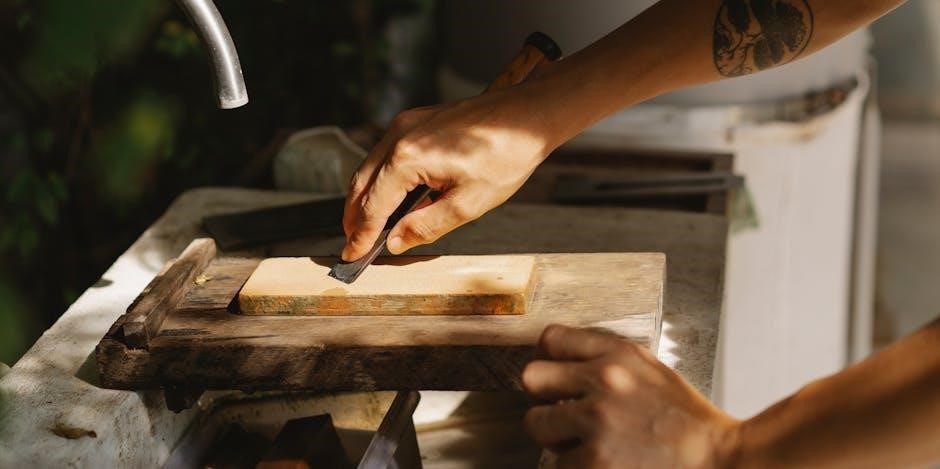
Understanding knife sharpening angles is crucial for optimal performance, heavily influenced by steel type, intended use, and even personal preference.
Finding the right angle ensures longevity and cutting efficiency;
Why Angle Matters in Knife Sharpening
The sharpening angle fundamentally dictates the knife’s edge geometry, directly impacting its cutting ability and durability. A smaller angle creates a thinner, sharper edge, excelling at precision tasks like slicing vegetables, but sacrificing robustness. Conversely, a larger angle yields a thicker, more durable edge, ideal for tougher jobs like batoning wood, though with reduced sharpness.
Consistency is paramount; varying the angle during sharpening results in an uneven edge, diminishing performance. The optimal angle isn’t fixed – it’s a balance between sharpness and edge retention, tailored to the steel type, intended use, and the user’s expectations for rough handling. Regularly inspecting the edge for rolls or chips provides valuable feedback for angle adjustments.
The Relationship Between Steel Type and Angle
Steel hardness and composition significantly influence the ideal sharpening angle. Softer steels require larger angles (25-30 degrees) to maintain edge retention, as they are more prone to rolling or chipping. Harder steels, however, can support much smaller angles (15-20 degrees) for exceptional sharpness, though they may become brittle and susceptible to chipping under heavy stress.
Sharpening systems allow for lower angles with harder steels, enhancing performance and edge retention. However, even with systems, exceeding a steel’s limitations can lead to increased chipping. Understanding your steel’s properties is crucial; a careful balance between sharpness and durability must be achieved through appropriate angle selection and mindful use.
Common Knife Sharpening Angles and Their Uses
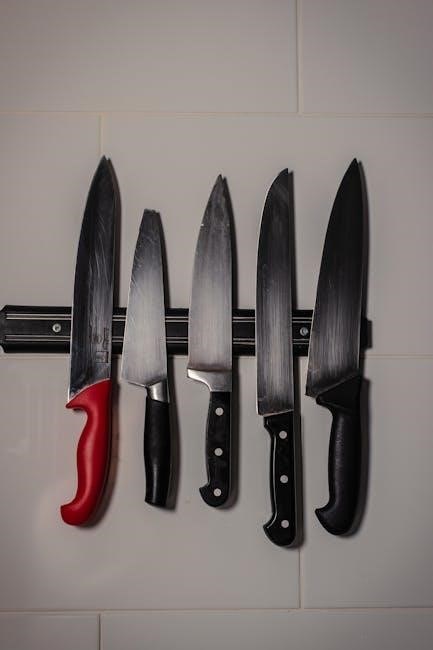
Different tasks demand different angles; precision cutting benefits from 15-20 degrees, general use from 20-25, and heavy-duty tasks from 25-30 degrees.
15-20 Degree Angle: For Precision Cutting
A 15-20 degree angle creates an exceptionally sharp edge, ideal for tasks demanding precision. Think slicing delicate meats, filleting fish, or intricate vegetable work where clean, effortless cuts are paramount. However, this acute angle comes with a trade-off: reduced durability. The thinner edge is more susceptible to rolling or chipping, especially when encountering resistance or harder materials.
Therefore, knives sharpened to this angle require careful handling and are best suited for softer substances. Sharpening systems can help achieve and maintain these lower angles, but the steel’s quality becomes even more critical. It’s a balance between ultimate sharpness and potential fragility, making it perfect for specialized culinary applications.
20-25 Degree Angle: General Purpose Knives
The 20-25 degree angle represents a sweet spot for most everyday knives, offering a versatile balance between sharpness and durability. This range is excellent for kitchen knives used for a wide variety of tasks – chopping vegetables, slicing fruits, trimming meats, and general food preparation. It provides sufficient edge strength to withstand moderate use without sacrificing too much cutting performance.
This angle is forgiving, making it a good choice for beginners learning to sharpen. It’s less prone to chipping than lower angles, and still capable of achieving a very usable, sharp edge. Most factory-produced knives arrive with an angle within this range, reflecting its practicality. It’s a reliable choice for those seeking a knife that can handle diverse kitchen duties.
25-30 Degree Angle: Heavy-Duty Knives & Outdoor Use
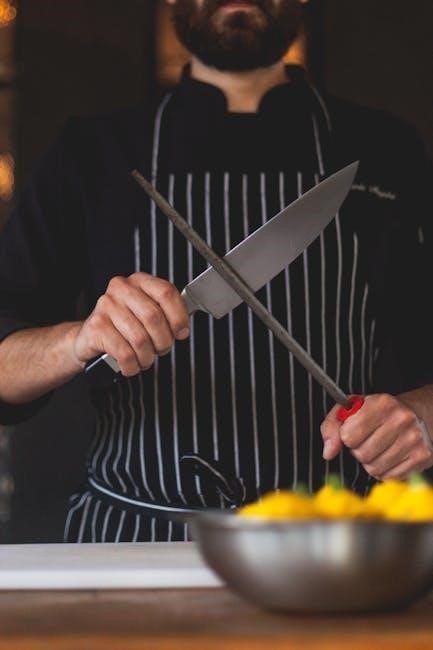
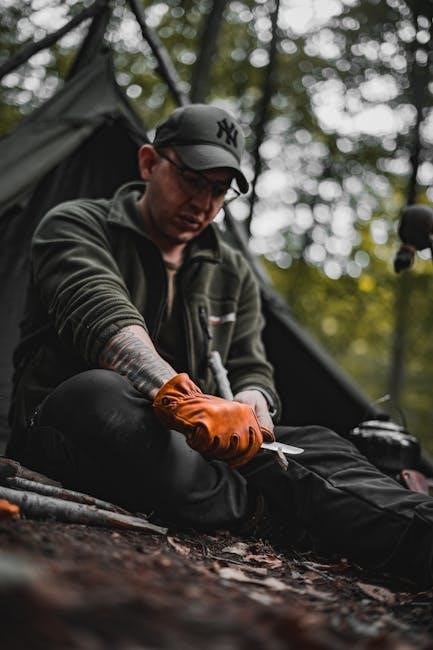
A 25-30 degree angle is ideal for knives designed for tougher tasks and more demanding environments. This robust angle is commonly found on hunting knives, bushcraft knives, and cleavers – tools expected to handle significant stress and potential abuse. The steeper angle creates a more durable edge, resisting rolling and chipping when encountering harder materials.
Outdoor enthusiasts and those working with fibrous materials like rope benefit from this increased durability. While not as acutely sharp as lower angles, the edge retention is superior, requiring less frequent sharpening during extended use. It’s a practical choice when prioritizing edge strength over ultimate slicing finesse, ensuring reliability when it matters most.

Determining the Correct Angle for Your Knife
Finding the ideal angle involves inspecting the existing bevel, utilizing tools like protractor apps, or employing techniques like the shadow method for accurate estimation.
Inspecting the Existing Bevel
Begin by carefully examining your knife’s existing bevel – the angled surface created during sharpening. This provides a crucial starting point. Look closely at the angle where the blade meets the shoulder; it’s a visual guide to the manufacturer’s intended edge.
Observe for any signs of damage like rolls (a rounded edge) or microchips. These indicate the current angle might be insufficient for your typical use. If damage is present, consider increasing the angle slightly during your next sharpening session. Conversely, if the edge is simply dulling from regular wear without visible damage, a slightly lower angle could improve cutting performance.
Remember, consistently referencing the existing bevel is a practical approach, even if you don’t achieve a perfectly precise angle. It’s a simple method that prioritizes functionality over absolute perfection, especially for everyday kitchen knives.
Using a Protractor App
Modern smartphones offer a convenient solution for angle estimation: protractor apps. Numerous free and paid options are available for both iOS and Android devices. Download a reputable app and calibrate it according to the instructions – ensuring accuracy is key.
To use the app, place the knife blade flat on a surface. Position your phone so the protractor’s reference line aligns with the blade’s edge. Slowly tilt the knife until the app indicates your desired angle (e.g., 20 degrees for a general-purpose knife).
Hold this angle steady as you begin sharpening, using the app as a visual guide. While not foolproof, a protractor app provides a reasonably accurate and accessible method for beginners to establish and maintain a consistent sharpening angle, improving overall results.
The Shadow Method for Angle Estimation
The shadow method is a low-tech, yet surprisingly effective, way to estimate a knife’s sharpening angle. Position a bright light source to cast a shadow of the blade’s edge onto a flat, light-colored surface.
Slowly raise or lower the knife’s spine, observing the shadow. The goal is to adjust the angle until the shadow of the edge appears as a single, thin line, effectively disappearing under the blade itself.
This indicates you’ve reached the existing bevel angle. While requiring practice to master, this method offers a visual reference without needing specialized tools, making it a useful skill for any knife enthusiast seeking consistent sharpening results.
Paper Wedge Technique
The paper wedge technique provides a tactile method for approximating a sharpening angle. Begin by placing a piece of paper flat on your sharpening surface.
Carefully position the knife blade on the paper, spine down, and gently lower it until the edge just makes contact. This creates a small wedge of paper between the blade and the surface.
The angle formed by the blade and the paper represents a starting point for your sharpening angle. While not precise, this method offers a consistent reference, especially useful for beginners.
Adjust the paper thickness to fine-tune the angle, remembering that consistency is more vital than absolute accuracy.
Adjusting the Angle Based on Knife Usage
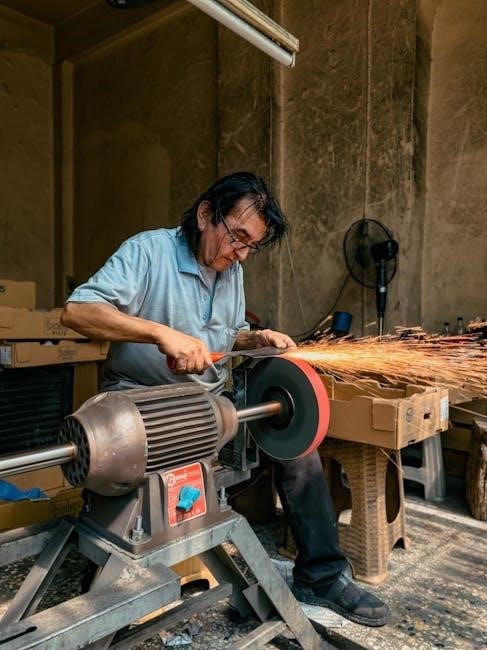
Knife usage dictates optimal angles; rope cutting benefits from higher angles, while cardboard demands lower ones, adapting to prevent damage and maintain sharpness.
Angle Adjustment for Rope Cutting
When tackling rope, a more obtuse angle – generally leaning towards the 25-30 degree range – is highly recommended. Rope fibers are abrasive and tend to roll the knife’s edge, leading to rapid dulling if the angle is too acute. Increasing the angle provides greater edge strength and resistance to this rolling effect.
However, simply defaulting to a high angle isn’t ideal. Regularly inspect the edge after rope cutting sessions. If you observe significant rolling or micro-chips, incrementally increase the angle further. Conversely, if the knife cuts cleanly with minimal edge deformation, you might cautiously reduce the angle slightly for improved slicing performance. The key is to find a balance between durability and cutting efficiency, tailored to the specific type of rope being cut and the steel’s characteristics.

Angle Adjustment for Cardboard Cutting
Cardboard presents a different challenge than rope; it’s less abrasive but can quickly dull an edge due to its fibrous nature and the pressure required for cutting. A slightly lower angle, around 20-25 degrees, often works well for cardboard, prioritizing slicing ability over sheer durability. However, the type of cardboard matters significantly.
Corrugated cardboard, with its layers, demands a more robust angle than thinner cardstock. Monitor the edge closely after each use. If you notice chipping or a feeling of “catching” during cuts, increase the angle incrementally. If the knife glides through effortlessly, you might experiment with a slightly lower angle for a cleaner cut. Remember, consistent inspection and adjustment are vital for maintaining optimal performance when using your knife on cardboard.
Responding to Edge Damage (Rolls & Chips)
Edge damage, manifesting as rolls or chips, is a clear signal that your current sharpening angle isn’t sufficient for the tasks you’re performing. Rolls indicate the edge is folding over, while chips represent actual material loss. When you observe either, immediately increase the sharpening angle by one or two degrees;
This creates a more durable, albeit slightly less acute, edge. Repeatedly assess the edge after sharpening and subsequent use. If damage persists despite the angle increase, consider the steel’s limitations or the nature of the materials you’re cutting; Don’t force a low angle on a steel that can’t support it; prioritize longevity over peak sharpness. Consistent monitoring and incremental adjustments are key to a resilient edge.
Sharpening Systems and Lower Angles
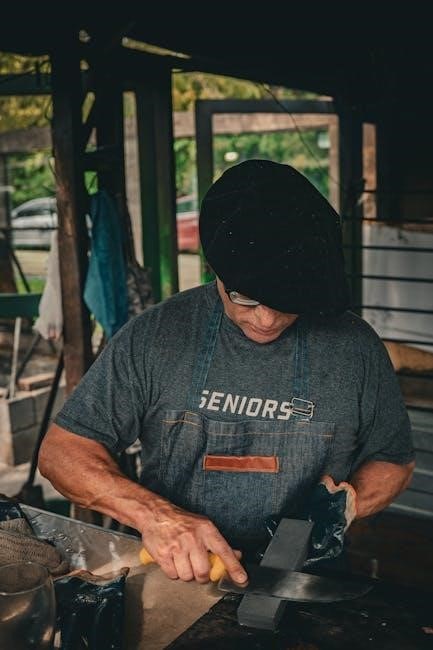
Utilizing sharpening systems allows for achieving and maintaining lower angles, enhancing performance and edge retention, but steel limitations must be considered to prevent chipping.
Benefits of Lower Angles with Systems
Sharpening systems offer a significant advantage when pursuing lower angles, leading to demonstrably superior cutting performance. These systems facilitate consistent angle maintenance, a critical factor often difficult to achieve with freehand methods; Lower angles reduce the amount of material needing displacement during a cut, resulting in a smoother, more effortless slicing experience.
Furthermore, a refined, lower angle enhances edge retention, meaning less frequent sharpening is required. However, it’s vital to acknowledge that not all steels are suited for extremely acute angles. Harder steels generally tolerate lower angles better, while softer steels may become prone to rolling or chipping. The trade-off between sharpness and durability must be carefully considered, aligning with the knife’s intended purpose and the user’s expectations for robustness.
Steel Limitations and Chip Resistance
While lower sharpening angles maximize sharpness and edge retention, steel composition dictates how acutely a knife can be sharpened without compromising durability. Softer steels, lacking substantial hardness, are more susceptible to rolling or chipping at lower angles, especially during demanding tasks. Higher alloy steels and those with proper heat treatment exhibit greater chip resistance.
Understanding a steel’s limitations is paramount. Pushing an angle too low for a given steel invites damage. Careful consideration of intended use is also crucial; a knife primarily used for delicate slicing can tolerate a lower angle than one subjected to rougher work. Regularly inspecting the edge for signs of damage and adjusting the angle accordingly is a practical approach to balancing sharpness and longevity.
Consistency is Key
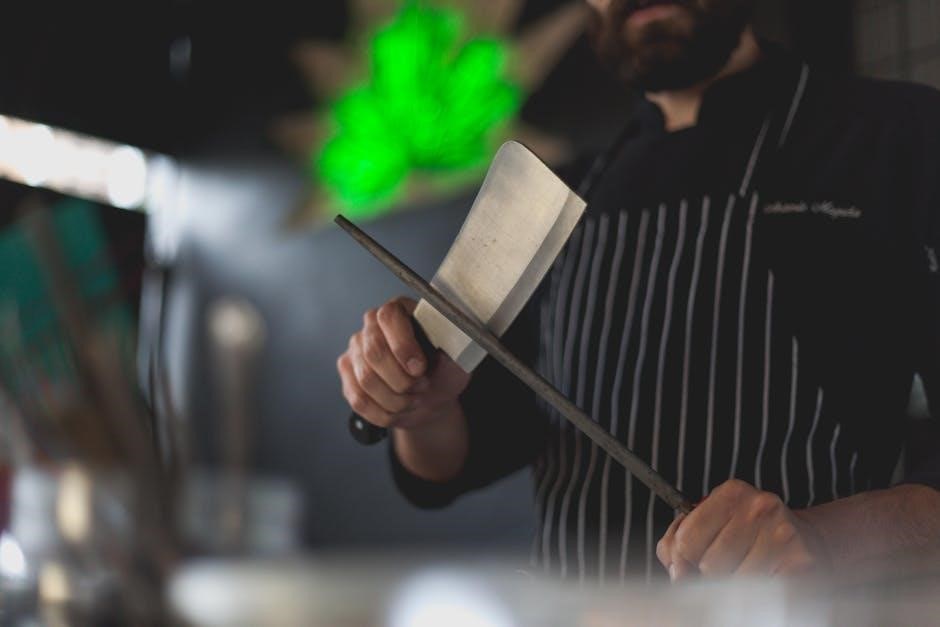
Maintaining a consistent sharpening angle is more vital than achieving a specific number; repeatable results depend on it, regardless of the chosen angle itself.
The Importance of Maintaining a Consistent Angle
Achieving a precise angle is less critical than consistently replicating that angle throughout the entire sharpening process. Variations lead to an uneven bevel, diminishing the knife’s performance and edge retention. Imagine sharpening, slightly altering the angle with each pass – the result will be a weak, unpredictable edge.
Focus on using the existing bevel as a guide, striving for uniformity. Even if the initial angle isn’t “perfect,” consistent execution yields a functional and durable edge. This is especially true when sharpening freehand. Sharpening systems aid consistency, allowing for lower angles, but even then, maintaining that angle is paramount. Ultimately, a consistently sharpened knife, even at a slightly less-than-ideal angle, will outperform one with an inconsistent bevel.
Practical Tips for Consistent Sharpening
To maintain a consistent angle, utilize readily available tools like protractor apps on your smartphone, offering a visual reference during sharpening. Alternatively, employ the “shadow method,” observing when the shadow disappears under the edge as you tilt the knife.
The paper wedge technique provides a tactile guide, creating a consistent angle for your sharpening stone. Regardless of the method, practice is key. Focus on slow, deliberate strokes, paying close attention to maintaining the established angle. Regularly inspect the bevel for uniformity. Remember, it’s about repetition and muscle memory. Don’t overthink it; just sharpen, referencing the existing bevel and adjusting slightly based on observed edge damage.
Beyond the Angle: Geometry and Heat Treat
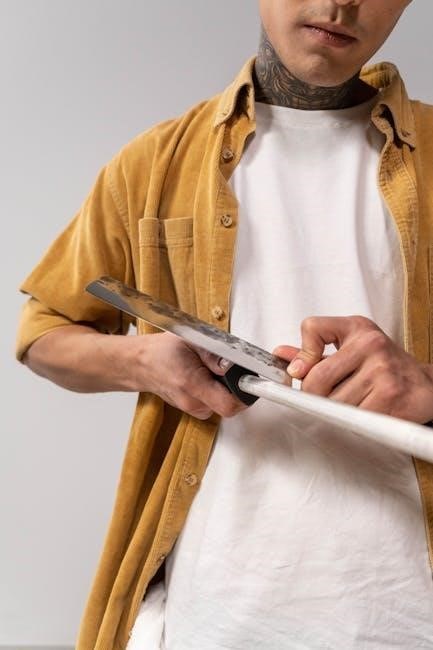
Knife geometry and the heat treatment process significantly impact optimal sharpening angles and edge retention, influencing how well a blade performs and resists damage.
How Geometry Influences Optimal Angle
The blade’s geometry, specifically its thickness and profile, plays a vital role in determining the ideal sharpening angle. Thicker blades, common in heavy-duty knives, generally benefit from higher angles for increased durability and resistance to rolling or chipping. Conversely, thinner blades designed for precision work thrive with lower angles, enhancing their slicing ability.
A convex grind, for example, distributes force differently than a flat grind, potentially requiring a slightly adjusted angle. The overall shape – whether it’s a drop point, clip point, or tanto – also influences how the edge engages with materials. Understanding these geometric nuances allows for a more tailored sharpening approach, maximizing the knife’s potential based on its inherent design. It’s about working with the blade’s form, not against it.
The Role of Heat Treatment in Edge Retention
Heat treatment fundamentally alters a steel’s hardness and toughness, directly impacting its ability to hold an edge. A properly heat-treated blade will maintain its sharpness for a longer duration, even at lower angles. Harder steels generally allow for finer, more acute angles, enhancing cutting performance, but can be more brittle and prone to chipping if not carefully used.
Conversely, softer steels require higher angles to compensate for their lower hardness, sacrificing some sharpness for increased durability. The specific heat treatment process – including hardening, tempering, and annealing – dictates the steel’s microstructure and, consequently, its edge retention capabilities. Therefore, understanding a steel’s heat treatment is paramount when selecting an appropriate sharpening angle.